

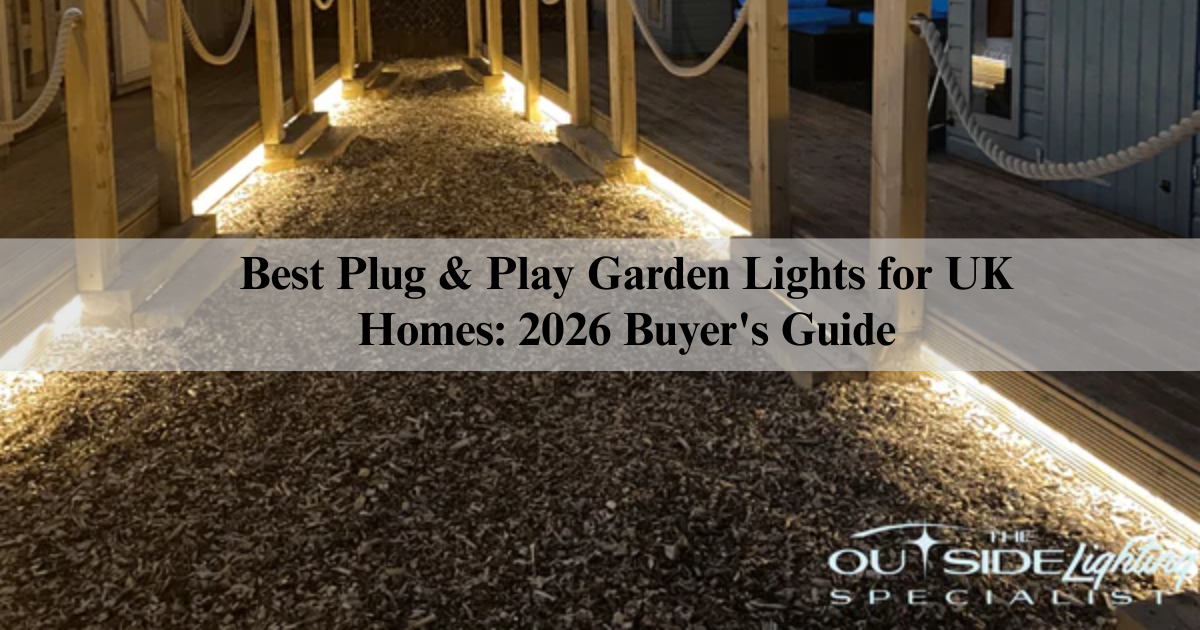
Transforming your garden with beautiful lighting used to mean hiring an electrician, digging trenches, and spending well over budget. Not anymore. Plug & play garden lighting has genuinely changed things for UK homeowners and in 2026, the systems available are safer, smarter, and more affordable than ever. Specialists like The Outside Lighting Specialist (TOLS) have spent years refining low-voltage outdoor lighting that anyone can install regardless of DIY experience. This guide covers everything you need to know before you spend a penny.
What Is Plug & Play Garden Lighting?
Plug & play garden lighting is a low-voltage (12V DC) modular outdoor lighting system that connects directly to a standard UK three-pin socket via a transformer. No hardwiring into mains supply No electrician. No building regulations to navigate.
The system works like this: a transformer converts mains voltage down to safe 12V DC power. A wiring harness then distributes that power to your chosen LED garden lights, stake lights, recessed in-ground lights, path lights, or LED strips, all connected using simple push-fit connectors. Because the output voltage is so low, it is completely safe to handle and legal for any homeowner to install throughout the UK.
Benefits Worth Knowing
No electrician costs. A qualified electrician for outdoor mains wiring typically costs £150–£400+. With plug & play, that cost simply does not exist.
Seriously energy efficient. A 3W LED stake light uses roughly the same electricity as a phone charger. Running ten lights for five hours a night costs pennies per week.
Modular and expandable. Start with a starter kit and add lights whenever you like. T-connectors, splitters, and extension cables let the system grow without replacing anything already installed.
Fully weatherproof. Quality plug & play lights carry IP65 or IP67 ratings — built to handle sustained rain, frost, and standing water. Essential for the UK climate.
Pros and Cons
|
Pros |
Cons |
|
No electrician or permits needed |
Requires a nearby outdoor socket |
|
Easy to install, move, and expand |
Cable management needs planning in large gardens |
|
Very low LED running costs |
One transformer has a wattage limit |
|
IP65/IP67 rated for UK weather |
Quality varies significantly between brands |
|
Child and pet safe at 12V |
Higher upfront cost than basic solar lights |
Plug & Play vs Solar — An Honest Comparison
|
Feature |
Plug & Play (12V LED) |
Solar Garden Lights |
|
Reliability |
Consistent every night |
Dependent on daylight hours |
|
Brightness |
High — 100–300+ lumens |
Low to medium, often fades by midnight |
|
UK Winter Performance |
Unaffected |
Often poor — short daylight hours |
|
Light Quality |
Warm white, consistent |
Often cool/blue or inconsistent |
|
Expandability |
Highly modular |
Each unit independent |
|
Lifespan |
25,000–35,000+ hours |
Battery degrades after 2–3 years |
|
Best for |
Year-round reliable lighting |
Casual summer accent lighting |
Verdict: For UK gardens where reliability matters — especially through autumn and winter — plug & play wins decisively. Solar is fine for summer accents; it cannot compete when the days get short.
Best Light Types for Different Garden Areas
Pathways and driveways: Recessed in-ground lights sit flush with the surface, guide footfall safely, and look genuinely architectural. The 3-way 3W in-ground variant works brilliantly at driveway junctions.
Borders and planting beds: Stake lights are the go-to. The 3W black LED garden stake light (IP67, 290 lumens, Cree LED, 35,000-hour lifespan, 40° beam) is purpose-built for uplighting shrubs and hedges with precision.
Decking and patios: Trimless flush-mount lights (0.5W) and recessed bezel lights (1–2W) sit invisibly into timber boards by day and cast warm, even light at night. A set of 10 recessed deck lights transforms even a plain patio.
Steps and risers: Side-emitting recessed path lights or low-wattage bezel lights give just enough illumination to be safe without ruining the aesthetic.
Pergolas and outdoor kitchens: A 4M warm white LED strip creates an even glow under a canopy ceiling, clean, modern, and incredibly effective.
Feature trees: A 10W stake light delivers the power needed to uplight a mature tree or large ornamental shrub as a proper focal point.
What Should You Expect to Pay?
|
System Size |
Approximate Cost |
|
Starter pack (4–6 lights + transformer + harness) |
£80–£130 |
|
Mid-size garden (10–15 lights) |
£150–£280 |
|
Large garden (20+ lights, multiple circuits) |
£300–£600+ |
|
Individual add-on lights |
£5–£33 per light |
|
60W transformer / driver |
£28–£50 |
|
Extension cables and connectors |
£2.50–£8 per piece |
These figures reflect quality IP65+ rated systems. Budget products may look cheaper but frequently fail within one or two winters — false economy in a UK climate.
Key Buying Considerations
Work through these before placing your order:
Transformer capacity. Add up the total wattage of all your chosen lights. Your transformer should handle that total with at least 20% headroom. A 60W driver comfortably powers up to 50W of lights.
IP rating for your installation. IP65 covers water jets from any direction — fine for most gardens. IP67 covers short-term submersion — choose this for in-ground or low-lying lights prone to puddles.
Colour temperature. Warm white (2700–3000K) is the right choice for almost every UK residential garden. It feels natural and inviting. Cool white (5000K+) tends to look clinical in domestic settings.
Expandability. Make sure extension cables, T-connectors, and splitters are available for your chosen system. Some brands use proprietary connectors that lock you in.
Socket location. Your transformer plugs into a standard three-pin socket. Plan your cable run from socket to garden before selecting cable lengths.
Common Mistakes to Avoid
Overloading the transformer. Going beyond 80% of its rated wattage causes flickering, premature failure, or both. Always leave headroom.
Choosing solar for year-round UK use. Short winter days simply do not provide enough charge. If you want reliable evening lighting from October through March, solar will disappoint.
Ignoring IP ratings. A light rated IP44 installed in a border that collects water will fail quickly. Match the rating to the environment.
Poor cable routing. Cables left exposed on the surface are a trip hazard and look untidy. Use cable clips, conduit, or bury under gravel or bark chipping.
Buyer's Checklist
Before you order, confirm the following:
- Outdoor socket accessible within cable reach
- Total wattage of chosen lights calculated
- Transformer capacity covers total watts + 20% headroom
- All lights rated IP65 or above
- Extension cables and connectors available for the system
- Warm white (2700–3000K) colour temperature selected
- Cable routing planned and trip hazards considered
- Starter pack or individual components chosen based on garden size
Transform Your Garden — Without Calling an Electrician
A well-lit garden adds real kerb appeal, extends the time you spend outside, and improves security without the cost or disruption of mains installation. Whether you are lighting a modest patio or a large landscaped garden, plug & play systems let you start small and expand as your ideas develop.
Explore the complete plug & play lighting range at The Outside Lighting Specialist (TOLS) — from starter packs and powerful 10W uplighters to recessed deck lights, colour-changing kits, and every connector and cable you need. Free UK delivery on orders over £75.
Frequently Asked Questions
Do plug & play garden lights need an electrician in the UK?
No. They operate at 12V via a transformer and connect to any standard three-pin socket. No qualifications, no permits, and no specialist knowledge required.
How many lights can one transformer run?
A 60W driver can power up to 50W of connected lights — roughly 16 x 3W stake lights or 8 x 6W lights on one circuit.
Are these lights suitable for UK winters?
Yes. IP65 and IP67 rated plug & play lights are built for year-round outdoor installation and perform consistently through rain and frost — unlike solar lights.
What is the lifespan of LED plug & play garden lights?
Quality LED lights typically last 25,000–35,000 hours. At five hours per night, that is 13–19 years of use.
What is the best colour temperature for garden lighting?
Warm white (2700–3000K) suits the vast majority of UK residential gardens — natural, inviting, and flattering to plants and outdoor living spaces.
Can I expand the system after installation?
Yes. The modular design means you can add lights, extend cables, or branch circuits at any time using T-connectors and splitters.

Leave a comment
This site is protected by hCaptcha and the hCaptcha Privacy Policy and Terms of Service apply.